The Lufthansa Cargo chief gives insight into the competitive world of logistics and air cargo industry.

Ashwin Bhat was appointed as new CEO of Lufthansa Cargo on 15 April 2023 and in this new role, he is responsible for product and sales. Prior to being CEO, he was appointed to the Executive Board of Lufthansa Cargo AG as CCO in 2021.
In 1999, he joined what was then Swisscargo and held various management positions, including revenue management, transport management and global area management. From 2015, Bhat headed the cargo business unit at Swiss International Air Lines.
He studied chemistry at the University of Mumbai, India. Bhat began his career with Airline Financial Support Services in India.
1. As CEO, what is your vision for Lufthansa Cargo in the next five years, and what key strategies will you implement to achieve that vision?
When it comes to strategy, we always relate it to our strong purpose of ‘Enabling Global Business’. Putting this into the centre of our action, we want to enable business for our customers that means offering premium and innovative solutions – with a worldwide presence. We believe in the power of collaboration both as a Lufthansa Cargo team as such but especially with our partners.
It is not only a people’s business but also a very dynamic one. It is therefore important to train the ‘agility muscle’ as a company in order to quickly react to changing market dynamics.
2. How do you plan to strengthen Lufthansa Cargo’s market position amidst increasing competition in the logistics and cargo industry?
The logistics and cargo industry has always been a competitive industry. Further growth always must go in line with our promise to continuously strive for excellence in service. We have made significant strides in this area, implementing new processes, and setting the bar even higher for ourselves. We are determined to deliver the level of quality, for which we are known, and we are taking every step necessary to enhance our reliability and flexibility.
One of our strengths is the strong route network that covers around 300 destinations in more than 100 countries, using both freighter aircraft and cargo capacity from passenger aircraft operated by Lufthansa, Austrian Airlines, Brussels Airlines, Discover Airlines and SunExpress, as well as trucks. 89 weekly B777F freighter connections worldwide, this is what we offer customers in our new winter flight schedule.
Complimenting our strength on the ground, with a comprehensive review of our existing schedule and network, we have been able to optimise our rotations making them even more sustainable and efficient.

3. Sustainability is becoming increasingly important in the logistics sector. What initiatives is Lufthansa Cargo implementing to reduce its carbon footprint?
As a leading international cargo airline, we enable global business and connect economies as sustainable as possible. Lufthansa Cargo is pursuing a clear strategy for a more sustainable future and, together with the Lufthansa Group and partners, has set itself ambitious climate protection targets: we aim to achieve a neutral CO2 balance by 2050 and to halve net CO2 emissions by 2030 compared to 2019.
As we are an airline, nearly 99% of our carbon footprint is caused by flying. That means our greatest CO2-saving potential lies in the air. In addition to the use of Sustainable Aviation Fuel (SAF), more sustainable aviation also requires major efforts for a modern fleet and efficiency improvements in flight operations. For example, fuel efficiency measures have saved approximately 9,000 metric tons of kerosene or 28,000 metric tons of CO2 emissions in 2024.
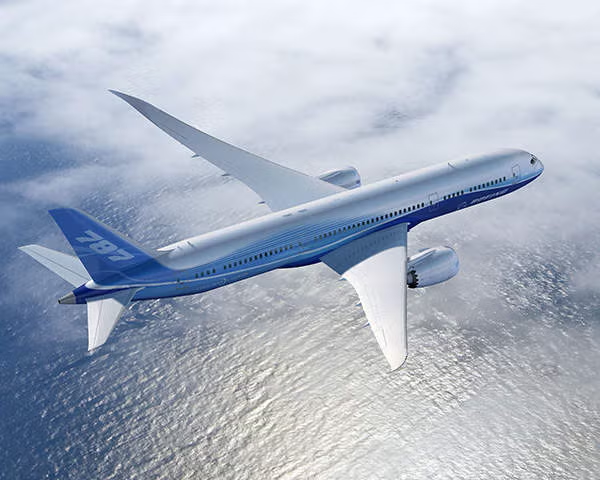
Since October 2021, we have switched our long-haul fleet completely to the Boeing 777F – today’s most modern freighter with the best environmental performance. We are delighted to have welcomed another efficient freighter – our 18th B777F – to our fleet at Frankfurt Airport on August 17, 2024.
Our latest aircraft is another important investment in our modern long-haul fleet and contributing in making air cargo more sustainable. A further seven Boeing 777-8 freighters featuring the latest technology have been ordered and are expected to be delivered by 2030.
4. How is Lufthansa Cargo leveraging technology to enhance operational efficiency and improve customer service?
Lufthansa Cargo is constantly working on ways to improve the customer experience and operational efficiency. This includes the use of new technologies.
The industry is starting to explore the use of AI/Machine Learning/Big Data. Effective application of these technologies will enhance transparency and efficiency of the whole supply chain.
In July, Lufthansa Cargo introduced the first AI assistant for internal documents to help employees quickly search and find information in sales and handling manuals.
IoT and automation (e.g. vehicles) will drive handling (warehouse) and maintenance efficiency. A pilot project to test two autonomous tow trucks has been running at the Frankfurt hub since August 2024. In the future, this could not only increase efficiency and quality at the hub, but also support the company’s resilience during personnel-related bottlenecks or peaks. Additional vehicles will be tested next year.
Due to the dynamic, global environment, air cargo demand is expected to be highly impacted by prevailing disruptions. We have seen the effect of the red-sea crisis or Typhoons this year on the industry. It can be expected that supply chains will remain under pressure from unforeseen political, economic or natural events.
5. In your experience, what are the biggest challenges currently facing the global cargo industry, and how is Lufthansa Cargo preparing to address them?
Firstly, due to the dynamic, global environment, air cargo demand is expected to be highly impacted by prevailing disruptions. We have seen the effect of the red-sea crisis or Typhoons this year on the industry. It can be expected that supply chains will remain under pressure from unforeseen political, economic or natural events. The increasing frequency of disruptions will continue to drive demand for the reliable, fast, flexible and secure mode of air transport.
Secondly, e-Commerce will probably remain a driving force behind the current growth we experience in global air cargo. Especially on the routes from China to Europe and the US this still new commodity is creating an additional need for air cargo capacity.
Thirdly, we observe that the global economy and especially trade is in the process of adjusting to new realities after Covid but also the political tensions in the world in recent years. It can be seen that trade is further diversifying and new air cargo markets are benefiting such as Vietnam or India. As this development is likely to continue air cargo growth is to continue especially is
The new flight schedule includes 50 frequencies to 17 destinations in Asia, reflecting the strong demand in the region. The growing e-Commerce industry, in particular, is driving this development, to which Lufthansa Cargo is able to respond quickly and flexibly thanks to its early preparations.
A significant development in the winter timetable is a transpacific flight: a weekly rotation of a B777F freighter connects Frankfurt via Ho Chi Minh City (SGN) with Los Angeles (LAX) and then returns to the home hub in Frankfurt. This is the cargo carrier’s first direct connection from the Asian market to the U.S. network, offering cargo customers an even faster, high-quality connection between the two continents.
With the expansion of new routes and direct connections, Lufthansa Cargo is underlining its long-term growth plans in a dynamic market environment and underlining its purpose of “Enabling Global Business”.
6. What steps are you taking to ensure that Lufthansa Cargo remains responsive to the changing needs of its customers?
Air cargo is a people business, and to understand customer needs, we as an organization need to be close to our customers. It is our endeavor to merge our digital capabilities with our physical capabilities. We will continue to ensure high accessibility of our services through digital sales (both own digital channels and marketplaces). Also, we continuously improve our network for our customers both with our own freighters and the passenger flights of the Lufthansa Group.
Together with partners from the whole logistics chain – especially forwarders but also airports, handling agents, IT providers etc. we will continue working on improving air cargo as a solution. As an example, Lufthansa Cargo is strongly supporting industry initiatives like IATA ONE Record (data standard) to make progress in digitalisation benefitting all – including shippers.
An important step in the further development of Lufthansa Cargo and its central cargo hub at Frankfurt Airport is the ‘LCCevo’ project. With an investment volume of almost 600 million euros, the cargo airline is focusing on a comprehensive modernisation by 2030, which will make the Lufthansa Cargo Center (LCC) Europe’s most modern airfreight hub.
7. As a skilled manager, how do you prioritise talent development within Lufthansa Cargo to ensure your team is equipped for future challenges?
In the air cargo sector, human expertise and decision-making are absolutely essential, even with all the advancements in technology. While technology has made huge improvements it’s still our people who drive success.
Our relationships with customers often make a difference. Trust, built through personal connections in sales and operations, is key to success. Ultimately, human judgment and experience ensure we adapt quickly and deliver the high level of service our clients rely on. Technology helps, but it’s the people on the ground, in the control rooms, and in leadership who make the real difference, ensuring operations stay on track and making key decisions in critical moments.
Our strategy, especially in key operational roles, is based on training, lifelong learning and development opportunities, both functional and non-functional. We receive regular employee feedback through our company-wide employee survey. And we provide young talent programs, apprenticeships and internships as a starting point of cargo careers.
8. Can you share any upcoming innovations or projects that you believe will significantly impact Lufthansa Cargo’s operations?
An important step in the further development of Lufthansa Cargo and its central cargo hub at Frankfurt Airport is the ‘LCCevo’ project. With an investment volume of almost 600 million euros, the cargo airline is focusing on a comprehensive modernisation by 2030, which will make the Lufthansa Cargo Center (LCC) Europe’s most modern airfreight hub.
Already, today, we handle more than 40,000 shipments, or more than 23,000 tons of cargo per week – arriving and departing at FRA on approximately 1,400 trucks per week and several hundred daily flights. The ‘LCCevo’ project strengthens the logistics hub’s competitive position in Europe and creates a modern, more sustainable infrastructure. The basic renovation will be carried out in stages, with cargo handling continuing seamlessly in the 330,000 m² Lufthansa Cargo Center.
In times of global tensions and changing customer demands, we need innovative solutions that meet our, our customers’ and society’s needs. This is only possible with a modern infrastructure. For our customers, we want to optimise efficiency and quality and make our service even faster and more seamless. For our employees, we want to create attractive and future-proof jobs for the next generations in our newly designed ‘Home of Cargo’. At the same time, “LCCevo” underscores our strong ties to our home base and strengthens Frankfurt Airport’s role as a central cargo hub in Europe.
9. Reflecting on recent global events, what lessons has Lufthansa Cargo learned about crisis management, and how will those lessons shape future strategies?
To react in an agile manner to unexpected changes in demand (both directions) it remains key to flexibly adjust capacity offer. ACMI or wetlease models can be one way to respond to more uncertainty in the market.
Moreover, using data smartly to better understand developments/trends and then deriving actions for pricing, revenue management or network planning is another success factor.
10. How important are collaborations and partnerships for Lufthansa Cargo’s growth, and what kinds of alliances are you exploring or considering?
Air cargo is always teamwork. To remain well positioned for the future – digitally, integrated, efficiently and sustainably – Lufthansa Cargo is working closely with customers, partners and authorities.
A current example of this is the intensification of strategically important partnerships in China. To this end, the company has signed cooperation agreements with the Shanghai Airport Authority, Air China Cargo and China Postal Express & Logistics Co., Ltd.