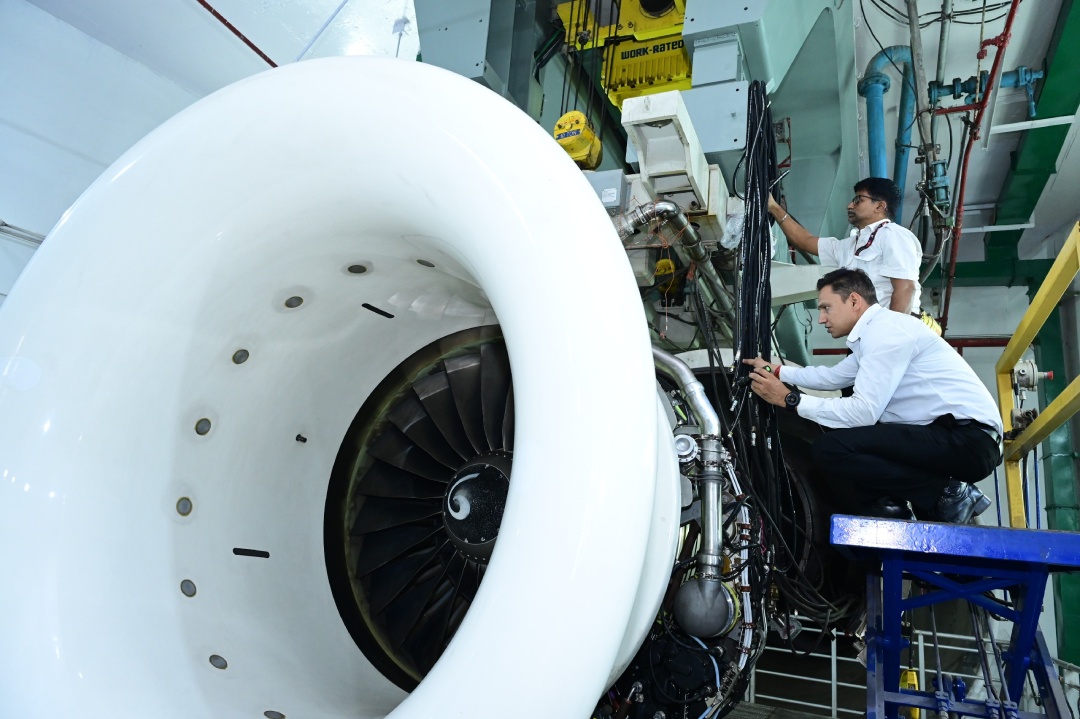
In this exclusive interview, Abhijeet Inamdar unveils how SiriNor’s groundbreaking propulsion system could redefine aviation’s green future.
June 5, 2025
2:55 PM
Is this a new era in jet propulsion?

As the aviation industry confronts one of its most urgent challenges—decarbonizing flight—solutions that once seemed decades away are fast becoming a reality. Among the global innovators leading this charge is SiriNor India, a deeptech aerospace startup with a bold ambition: to create the world’s first all-electric jet engine capable of delivering zero-emission flight at industry-grade performance levels.
At the helm of this technological breakthrough is Abhijeet Inamdar, Cofounder and CEO of SiriNor India.
“Developing a high-thrust, all-electric jet engine without compromising safety was our biggest engineering hurdle,” says Inamdar. Traditional jet engines rely on combustion chambers, complex shaft systems, and expensive heat-resistant superalloys. SiriNor’s engineers turned that model on its head.
The result? A patented tip-driven electric jet engine that eliminates combustion entirely and operates without shafts or gearboxes. Instead, the propulsion system uses distributed edge-mounted motors and advanced 3D-printed components, resulting in significantly lower operating temperatures and simplified mechanics.
During SiriNor’s Technology Readiness Level 6 (TRL 6) test in Pune, the prototype exceeded expectations—achieving 60,000 RPM (vs. a 40,000 RPM target) and delivering 10 kgf thrust. By using more accessible aerospace-grade aluminum and steel alloys, the engine also achieves a tenfold increase in lifespan compared to traditional combustion engines.
“Our next challenge is scaling production using precision CNC vendors across India,” says Inamdar, citing ongoing partnerships in Pune, Bangalore, Coimbatore, and Hyderabad.
Clean propulsion without compromise
While the clean aviation sector has seen a proliferation of small electric ducted fans (typically under 1 kN thrust), these systems are limited to short-range mobility like eVTOLs. SiriNor’s engine is designed to break that barrier.
“Our propulsion platform is scalable—from 1 kN to over 90 kN, which means it can power everything from UAVs to regional jets,” says Inamdar. “Unlike hub-driven systems, our tip-turbine design requires less power to generate high thrust.”
What makes the technology even more future-ready is its power-source agnostic architecture. Whether powered by today’s batteries or tomorrow’s hydrogen fuel cells, SiriNor’s engine doesn’t need redesigning.
“This flexibility gives us a unique edge as energy ecosystems evolve. With fewer moving parts, manufacturing costs are reduced by at least 30%, and maintenance costs by 40%,” notes Inamdar.
Battery constraints and a phased strategy
Electric aviation’s skeptics often point to the limited energy density of batteries as a fundamental bottleneck. Inamdar acknowledges this reality and has planned SiriNor engine’s rollout accordingly.
“Our phased strategy starts with Unmanned Aerial Vehicles (UAVs) and Ground Effect Vehicles, which align with current battery capabilities,” Inamdar explains. These platforms, used for civil and defense operations, are expected to be operational by 2026–2028.
By 2030, SiriNor aims to scale to urban air mobility vehicles and small jets (up to 20 passengers), followed by regional and narrow-body aircraft like the A320 by 2035. These aircraft types, operating short-haul routes with predictable demand, are ideal candidates for early electrification.
Feasibility studies also show that combining advanced batteries with hydrogen fuel cells could allow ranges up to 4,000 km, which would cover 60% of global aviation routes, including most domestic flights in the U.S., EU, India, and Southeast Asia.
Beyond the engine: Ecosystem influence
According to the World Economic Forum’s Global Aviation Sustainability Outlook 2025, aviation emissions could rise to 22% of global GHG emissions by 2050. While Sustainable Aviation Fuel (SAF) offers partial reductions, SiriNor’s non-combustion, power-agnostic architecture promises full elimination of greenhouse gas emissions from propulsion.
But SiriNor’s impact doesn’t stop at engineering. The company is helping shape the ecosystem required to support electric aviation—from certification pathways to airport readiness.
“There are no mature regulatory frameworks for electric jet engines today,” says Inamdar. “That’s why we’re engaging proactively with bodies like EASA and DGCA to co-develop these standards.”
One of SiriNor’s quieter—but equally disruptive—advantages is noise. The electric engine generates under 70 dB, significantly lower than traditional jets, which could allow airports to operate 24/7—a game-changer for urban hubs.
SiriNor is already in talks with regulators and has signed seven Letters of Intent with customers in India, the U.S., and Europe, including FloFly, Genser, and Leviathan. Inamdar also emphasizes SiriNor’s “retrofit-ready” design, which allows integration into existing airframes without requiring full aircraft redesigns—a critical step for faster adoption.
A Made-in-India innovation
With its core engineering and manufacturing footprint rooted in India, SiriNor is showcasing the country’s emerging role as a global aerospace innovation hub. Simultaneously, the startup is expanding globally, securing manufacturing partnerships in Europe, the U.S., and Canada.
“Our mission is simple,” says Inamdar. “To make zero-emission flight not just possible—but practical, scalable, and accessible.”
As the world celebrates World Environment Day, SiriNor’s progress is a powerful reminder that the future of clean aviation is not a distant dream. It’s being built today—in labs, test beds, and CNC shops—and it may take off sooner than we think.

Shweta Nair
With over 10 years of editorial experience, Shweta has worked with reputed media organisations in India and the GCC region. As the editor of Aviation 360, she aims to bring a global perspective of the aviation industry to the publication. Apart from work, Shweta loves travelling, exploring new cultures and connecting with people from all walks of life.
Subscribe to Our Newsletter
Keep in touch with our news & offers
Thank you for subscribing to the newsletter.
Oops. Something went wrong. Please try again later.