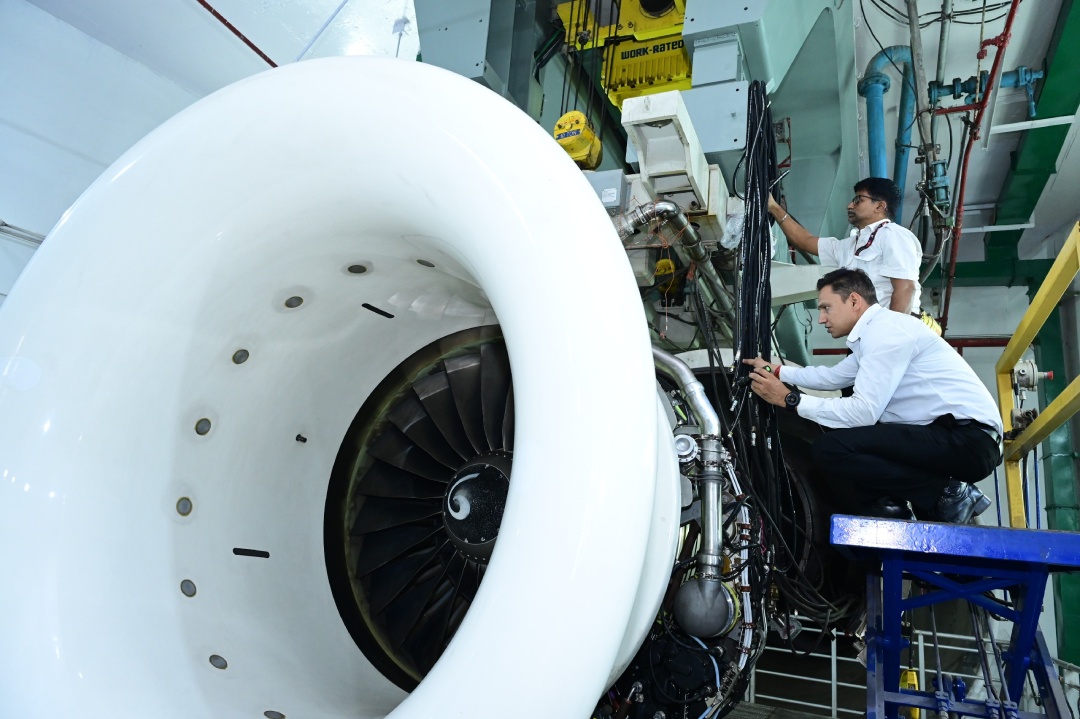
At present, only around 15 per cent of total maintenance is managed by domestic MROs, largely because major tasks, including engine overhauls, are outsourced to international providers.
June 27, 2025
10:00 AM
Global players eye India’s MRO boom

India is now the third-largest aviation market globally. According to the Ministry of Civil Aviation, the number of air passengers annually surpassed 350 million in 2024.
Domestic air passenger traffic alone grew by 5.9 per cent in the January-November period of 2024 compared to the same period in 2023, crossing the milestone of 5 lakh passengers in a single day for the first time in November last year.
According to another report released by ratings agency CareEdge, India’s air passenger traffic is likely to continue rising at a nine per cent CAGR between FY2025 and FY2027, taking the passenger volume to approximately 485 million in the next two years.
Major Indian carriers are preparing for this fast growth by ordering new planes and leasing their fleets. As a result, the total number of aircraft, especially larger wide-body jets, is expected to rise by around six to seven per cent annually.
Recent research by Statista projects that the estimated total number of fleets operated by Indian carriers is 941 in 2025, and is expected to increase significantly, reaching over 3,000 by 2047.
With rising demand, high capital requirements for new aircraft, and ongoing global supply chain delays, the aviation industry is also increasingly turning to leasing, which offers financial flexibility, lower operational costs, and the ability to scale capacity based on market needs.
India has recently taken a significant step forward by passing the ‘Protection of Interest in Aircraft Objects Bill’ in both houses of Parliament. This move aligns the country’s leasing framework with global standards and strengthens its compliance under the Cape Town Convention.
Although India signed the Convention in 2008, it was not ratified until now, leaving lessors uncertain about aircraft repossession and driving leasing costs 8 to 10 per cent higher than in many other countries. With this new Bill in place, those gaps are being addressed through a stronger legal structure that increases confidence among lessors and helps bring leasing costs in line with international standards.
The emergence of GIFT IFSC (Gujarat International Finance Tec-city-based International Financial Services Centre) is also helping leasing, with the Directorate General of Civil Aviation (DGCA) exempting lessors registered in GIFT City from obtaining prior approval for importing or acquiring aircraft on lease.
On the infrastructure front, the government has already announced plans to build 350 airports by 2047, of which 34 will be mega airports handling two crore passengers annually. In the next five years, the target is to open 50 more airports, while regional connectivity schemes like UDAN will increase connections to tier-II and tier-III cities.
One key segment likely to benefit is Maintenance, Repair, and Overhaul (MRO) services. This network, which includes Original Equipment Manufacturers (OEMs), airline operators, service providers, vendors, and manufacturers of parts and components like airframes, engines, and line maintenance, now has significant expansion opportunities in India.
In the coming years, Indian carriers that have placed large aircraft orders will begin receiving deliveries of newer and more advanced aircraft, pushing MRO demand further. However, there are too few MROs in India to handle the volume.
At present, only around 15 per cent of total maintenance is managed by domestic MROs, largely because major tasks, including engine overhauls, are outsourced to international providers.
We need more local facilities capable of conducting engine checks, comprehensive maintenance, and improved technical integration. Equally important is developing a skilled workforce equipped to manage advanced engine servicing. Expanding hangar capacity and related infrastructure is hence crucial. Building stronger partnerships with OEMs to boost domestic manufacturing of spare parts can help reduce import dependency.
A coordinated push from the Civil Aviation Ministry, private manufacturers, airlines, and government bodies will accelerate infrastructure development. Strategic investments in skill-building programmes and research collaborations with tech innovators will also play a key role.
Leading airlines in India are now looking to establish their own MRO units. Air India is already planning the construction of its advanced MRO facility, which, according to reports, is set to be built on 35 acres near the Bengaluru International Airport.
Recently, the Odisha Government announced plans to create an investor-friendly policy to attract MRO players and OEMs. The state also intends to collaborate with the Government of Singapore to adopt global best practices in MRO operations.
In summation, the Indian MRO sector will likely witness an influx of overseas investment, a trend expected to grow substantially in the coming years. This can take the form of joint ventures or partnerships with airlines, offering a significant opportunity for global MRO players to invest, collaborate, and contribute meaningfully to India’s aviation MRO ecosystem.

Jaideep Mirchandani
Jaideep is the Group Chairman of Sky One, a global aviation holding entity managing a fleet of over 60 aircraft and helicopters. His strategic vision has positioned Sky One as a key player in emerging markets like India and the Middle East, driving innovation and sustainability in aviation.
Subscribe to Our Newsletter
Keep in touch with our news & offers
Thank you for subscribing to the newsletter.
Oops. Something went wrong. Please try again later.