In this exclusive interview, Nuno Sampaio Nunes offers a rare inside look at how Macau International Airport is redefining aviation security to meet the demands of a new era.

As global aviation navigates a post-pandemic resurgence, airport security is no longer confined to X-ray machines and walk-through scanners.
It is becoming a dynamic, multi-dimensional practice shaped by technological innovation, cultural transformation, and an ever-expanding threat landscape. At the heart of this evolution is Macau International Airport (CAM) — a mid-sized yet highly strategic airport that is emerging as a model of modern security integration.
Leading this charge is Nuno Sampaio Nunes, the airport’s AVSEC QC Manager & Security and Works Coordinator Manager. With a global mindset and local accountability, Nunes has helped Macau International Airport translate high-level security policy into tangible, tech-forward operational strategy.
In this exclusive Aviation 360 interview, he offers a rare inside look at how CAM is reshaping security culture, introducing new technologies, and preparing personnel for threats that didn’t exist even a decade ago.
From concept to core competency
Security, Nunes emphasizes, is not merely about surveillance systems and procedural rigor. It’s about people. “The security culture at Macau International Airport has always been a key factor in our operations,” he says. “Even the most advanced screening or access control technologies are ineffective without a strong mindset behind them.”
During the COVID-19 pandemic, the airport saw an opportunity to deepen this cultural commitment. Collaborating closely with the Civil Aviation Authority, CAM introduced a series of proactive initiatives — most notably, an in-house developed Anonymous Voluntary Reporting System, enabling staff to report concerns without fear of retribution.
Additionally, the airport rolled out annual security awareness posters, enhanced training across the board, and bolstered communication with stakeholders. Even frontline health measures like PPE use and physical counter protection were integrated into overall security protocols. “We don’t just want compliance,” Nunes says. “We want engagement. That’s how you build resilience.”
Seamless travel with smarter threat detection
Today’s passengers expect more than just safety — they expect it to be invisible. Achieving that balance is at the heart of CAM’s current upgrade initiatives.
“Our airport is undergoing a full renovation of its passenger security checkpoint,” reveals Nunes. “We’re introducing smart security lanes, millimeter-wave body scanners, and seamless biometric systems — all designed to enhance both security and passenger experience.”
Central to this overhaul is ONE ID, a biometric initiative that allows travelers to check in, clear security, and board using a single digital identity. “This kind of integration is the future,” Nunes adds. “But it won’t work without the human factor.”
To ensure success, CAM places a heavy emphasis on staff training. From early-stage familiarization with new equipment to feedback-driven performance improvements, Nunes believes that involving frontline workers throughout the process is non-negotiable. “Technology must serve people — not the other way around,” he says. “When staff understand how tools fit into their daily roles, security becomes seamless and sustainable.”
Training for the threats of tomorrow
While traditional threats like unauthorized access and baggage tampering still exist, the aviation sector now faces a new generation of risks: cybersecurity breaches, drone incursions, and hybrid attacks that target both digital and physical infrastructure.
To stay ahead, CAM has developed a risk-based training strategy that supplements Civil Aviation Authority requirements with internally designed modules. “Our training isn’t just reactive,” Nunes notes. “It anticipates future risks.”
Cybersecurity awareness is now part of the airport’s standard training protocol. Additionally, tenants and third-party contractors — from duty-free staff to maintenance crews — receive tailored security briefings based on their roles. CAM also maintains strict oversight of outsourced partners, ensuring alignment with AVSEC standards.
On the drone front, CAM benefits from stringent government-led no-fly zones around its airspace. “We’ve never had a drone incident to date,” says Nunes. “That’s a testament to clear regulation and enforcement.”
The new currency of aviation security
In an interconnected industry, no airport is an island. Nunes is a vocal advocate for international collaboration and information sharing, particularly through platforms like Airports Council International (ACI).
“Security threats don’t respect borders,” he says. “Being able to exchange real-time intelligence and best practices with regional airports helps us stay proactive, not just reactive.”
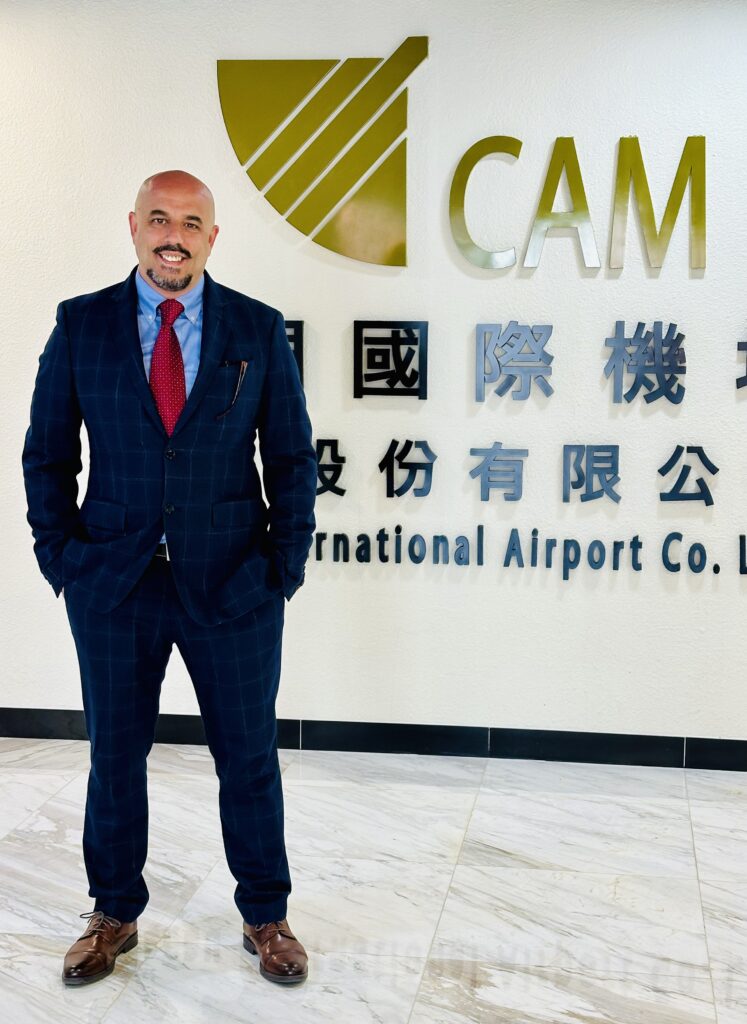
Nuno Sampaio Nunes, AVSEC QC Manager & Security & Works Coordinator Manager at Macau International Airport
As the AVSEC representative for CAM at ACI, Nunes regularly engages with peers across the Asia-Pacific region. These relationships have helped CAM adopt forward-looking measures even before certain threats become widespread. “The more incidents we see globally, the more we realize that collective action is not just ideal — it’s essential,” he adds.
Turning travelers into security allies
Perhaps one of the most overlooked elements of airport security is passenger behavior. In Nunes’ view, passengers are not just stakeholders — they are frontline participants in the airport’s security ecosystem.
“Educating our passengers is a core pillar of our security culture,” he explains. CAM uses a combination of social media, airport signage, public announcements, and staff engagement to keep travelers informed. “We want to demystify the security process,” says Nunes. “It’s not a monster — it’s there to protect them.”
Even CAM’s outsourced security personnel are trained in customer service skills to ensure passengers feel guided, not scrutinized. “A well-informed passenger is a cooperative passenger,” Nunes adds. “And that makes everyone’s job easier — and safer.”
A blueprint for the future
As Macau International Airport continues to evolve, Nunes remains clear-eyed about the challenges — and the opportunities — ahead. “We can’t afford complacency,” he says. “Security is not a destination. It’s a continuous journey.”
From cutting-edge technologies to grassroots culture-building, CAM is creating a replicable model for airports worldwide — one that sees passengers not as liabilities to be managed, but as partners in a shared mission. In Nunes’ words, “The best security systems are those that travelers never notice, but always feel safe within.”