Jigar D Mehta highlights how digital twins and automation are transforming airport operations.
By Jigar D Mehta
Walk through any major airport terminal on a busy morning and you witness what looks, on the surface, like a seamless operation. Departures boards refresh in real time. Climate control adjusts silently as passenger volumes shift. Security lanes open before queues have a chance to form. None of this happens by accident, and increasingly, very little of it happens because a human operator noticed something and responded in time.
What most passengers never see is the layer of intelligence beneath it all. Increasingly, that intelligence has a name: the Digital Twin. For those of us designing and delivering complex airport infrastructure, it has moved beyond an interesting concept to become an operational backbone. Combined with automation and real-time IoT, it is reshaping how airports are designed, commissioned, and managed.

Founder & CEO
Sankalit Consultant
From Data Noise to Operational Intelligence
Modern airports are extremely data-rich environments, with thousands of sensors tracking HVAC performance, passenger occupancy, baggage carousel loads, access control events, fire system status, and power distribution health. In most airports today, much of this data remains isolated – locked within individual building management systems that cannot communicate effectively.
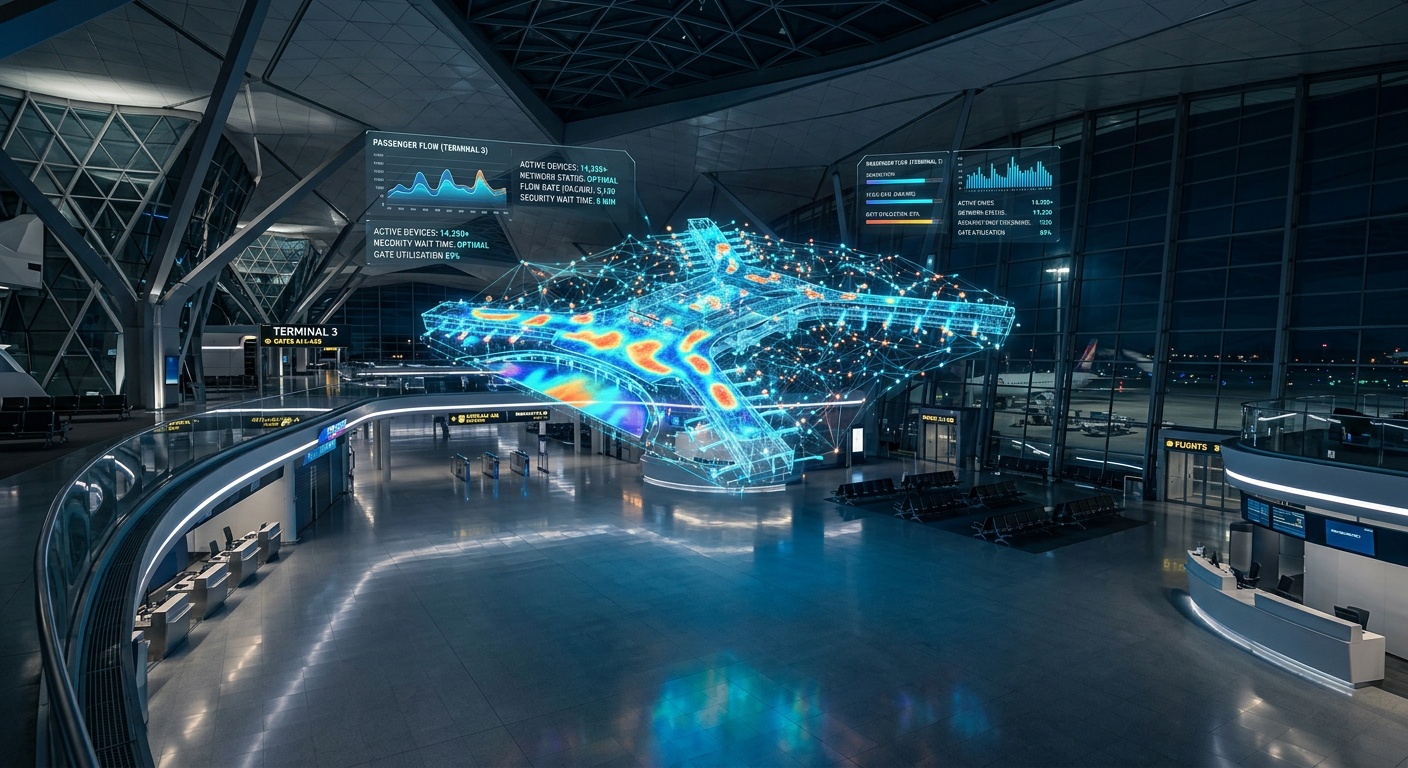
This fragmentation is exactly what the Digital Twin addresses. By pulling live data streams from IoT-connected devices across all building and operational systems into a single, georeferenced virtual model, it coverts disconnected sensor noise into structured actionable intelligence. An engineer no longer needs to navigate a dozen separate dashboards to understand why a remote pier is overheating at 2:00 a.m. The answer surfaces in context – spatially mapped, timestamped, and linked directly to the asset in question.
What makes the 3D Digital Twin particularly compelling is how it presents information. A photorealistic, real-time model of the terminal mirrors the physical environment, removing the need to translate abstract data. Even less experienced staff can identify faults, locate them accurately, and respond with the same confidence, providing a significant advantage where operational continuity and quick decision-making are crucial.
For airports running 20-plus hours a day with near-zero tolerance for downtime, the shift from reactive to real-time awareness and response is not an incremental improvement. It is a different way of operating.
Predictive Maintenance: From Break-Fix to Anticipate-and-Act
Of all Digital Twin applications, predictive maintenance stands out for its immediate financial impact. Traditional airport maintenance – scheduled replacement and reactive repair – is inherently inefficient: scheduled tasks discard still-functional components, while reactive fixes cause costly, unplanned downtime.
Digital Twins transform this approach by continuously monitoring each critical asset, such as chillers, lifts, baggage motors, and power units, creating dynamic health profiles. Deviations from normal performance are flagged early, enabling interventions before failures occur, reducing waste, minimizing downtime, and cutting operational costs.
In practice: an engineering team receives an alert that a baggage conveyor motor is drawing 12% above its normal load – days before a likely failure during peak operations. The intervention is scheduled overnight, avoiding disruption entirely. At Bergen and Oslo airports, BEUMER Flow Twin has enabled this shift from reactive guesswork about system health to data-driven insight.
Multiply this across hundreds of critical assets, the impact is significant. Maintenance teams move from firefighting to strategic asset management, reducing operational risk, and delivering benefits far beyond the maintenance budget line.
Decongesting the Terminal: Giving Passengers Back Their Time
There is a scenario that plays out at busy airports across the world every day. A long-haul flight lands early while another to the same gate is delayed by 40 minutes. Check-in counters and security lanes are set for the original schedule. Within 20 minutes, queues form that take an hour to clear. Passengers who should be shopping or relaxing are stuck, frustrated, and not spending, leaving a lasting mark on satisfaction scores.
This is not an operational failure – the airport has the data it needs to respond. What’s missing is the ability to process that information quickly enough to act pre-emptively. Digital Twins combined with automation bridge this gap, preventing congestion before it starts.
A Digital Twin running continuous flow simulations against live flight data, occupancy sensors, and check-in feeds can identify developing pinch points 15-20 minutes before they become visible. Automation responds: Additional counters activate, self-service kiosks open, security staffing dynamically adjusts, and digital wayfinding directs passengers along less congested routes. Queues that would have built over an hour are absorbed before most travellers notice.
The result is not just a shorter queue. Passengers clearing check-in and security in 18 minutes instead of 45 regain 27 minutes of discretionary time. Airport commercial teams know dwell time drives retail and food & beverage revenue. Digital Twin-driven automation adds the ability to actively engineer that dwell time predictably, consistently, and in real time, responding to actual conditions rather than idealized assumptions.
That argument, framed properly, belongs not in a technology budget conversation but in a commercial strategy one.
The Airports Already Living This
The evidence at this point is not theoretical. Changi Airport’s implementation of a Digital Twin at Terminal 4 – developed with Dassault Systèmes, Autodesk, and Siemens – allowed planners to model, simulate, and optimise operations before the terminal opened, and has continued to support real-time decision-making since. London Heathrow’s Terminal 2 is deploying a 3D Flow Twin visualisation of its baggage handling infrastructure, giving the operations team live, intuitive visibility into complex and failure-sensitive systems in the building.
The UAE has been among the most active adopters of Digital Twin technology in the region. Dubai’s airport infrastructure and Abu Dhabi’s broader digital twin programme – which uses 3D modelling, LiDAR scanning, and real-time data feeds across the emirate’s transport infrastructure – reflect a regional understanding that data-driven operational intelligence is not a future investment. It is a present competitive advantage.
Across these implementations the differentiator is not the vendor, budget, or geography. It is an early deliberate decision to treat data as a central operational asset. Airports that have done this are measurably outperforming others in uptime, passenger satisfaction, energy efficiency, and commercial revenue per passenger.
The Decision That Matters Most
None of this delivers on its promise without the right foundations. Digital Twin platforms rely on structured, high-quality data from the start: accurate asset registers, properly tagged equipment, IoT-ready infrastructure, and commissioning processes that treat data handover with the same rigour as physical delivery.
From my experience across airport projects – from masterplanning to operational handover – the same gap appears repeatedly. The projects that struggle Digital Twin implementation often treated building intelligence as a procurement item rather than a design discipline, introducing it too late and without a coherent operational framework.
The airports getting it right changed that sequence. Operational intelligence thinking entered the project at master planning. It was specified through detailed design. It was held to account through structured commissioning. The technology, in those projects, does what it promises – because the groundwork was laid for it to do so.
The Question Worth Asking
The industry conversation has moved past whether Digital Twins belong in airport infrastructure. That question is settled. The more useful one now is whether the teams responsible for delivering these projects – designers, consultants, contractors, operators – are genuinely prepared to implement them with the discipline they require.
The co-pilot is ready. What remains is the commitment to use it properly.
——————————————————————————————————-
About the author: Jigar Mehta is the Founder & CEO of Sankalit Consultant, a multi-disciplinary ICT, MEP and infrastructure consultancy. Over a decade, he has contributed to 12+ airport projects across the full lifecycle, from planning and design to handover and commissioning.